Anyone living in a historic building, in a building with strict management rules, or who simply doesn’t want an outdoor unit in view, has often been told that air conditioning with no outdoor unit doesn’t exist, or that if it does, it comes at the cost of performance and efficiency. At Parkair we have spent over two decades working on exactly this: the technology to condition a building without installing anything on the façade is mature, and covers most residential and commercial contexts.
What “no outdoor unit” really means
A traditional air conditioning system exchanges heat with the outside through a condensing unit, the metal box visible on balconies and façades. A system with no outdoor unit keeps the same refrigeration cycle, but houses all the components inside the building, eliminating the visible condensing unit on the façade.
The two best known technology families
Our range of no-outdoor-unit air conditioning products includes the two best known technology families:
- water-condensing systems (Parkair Water/Air range, MCW 2.0)
- internally installed air-condensing systems (Parkair Air/Air range, MCA 2.0)
Each of these families answers different system and architectural requirements, but all share the same goal: conditioning without any unit visible on the façade.
How do water-condensing systems work (Water/Air)?
Unlike traditional air-condensing units, a Water/Air system doesn’t exchange heat directly with the outside air: it releases it into a water circuit, connected to the building’s water system.
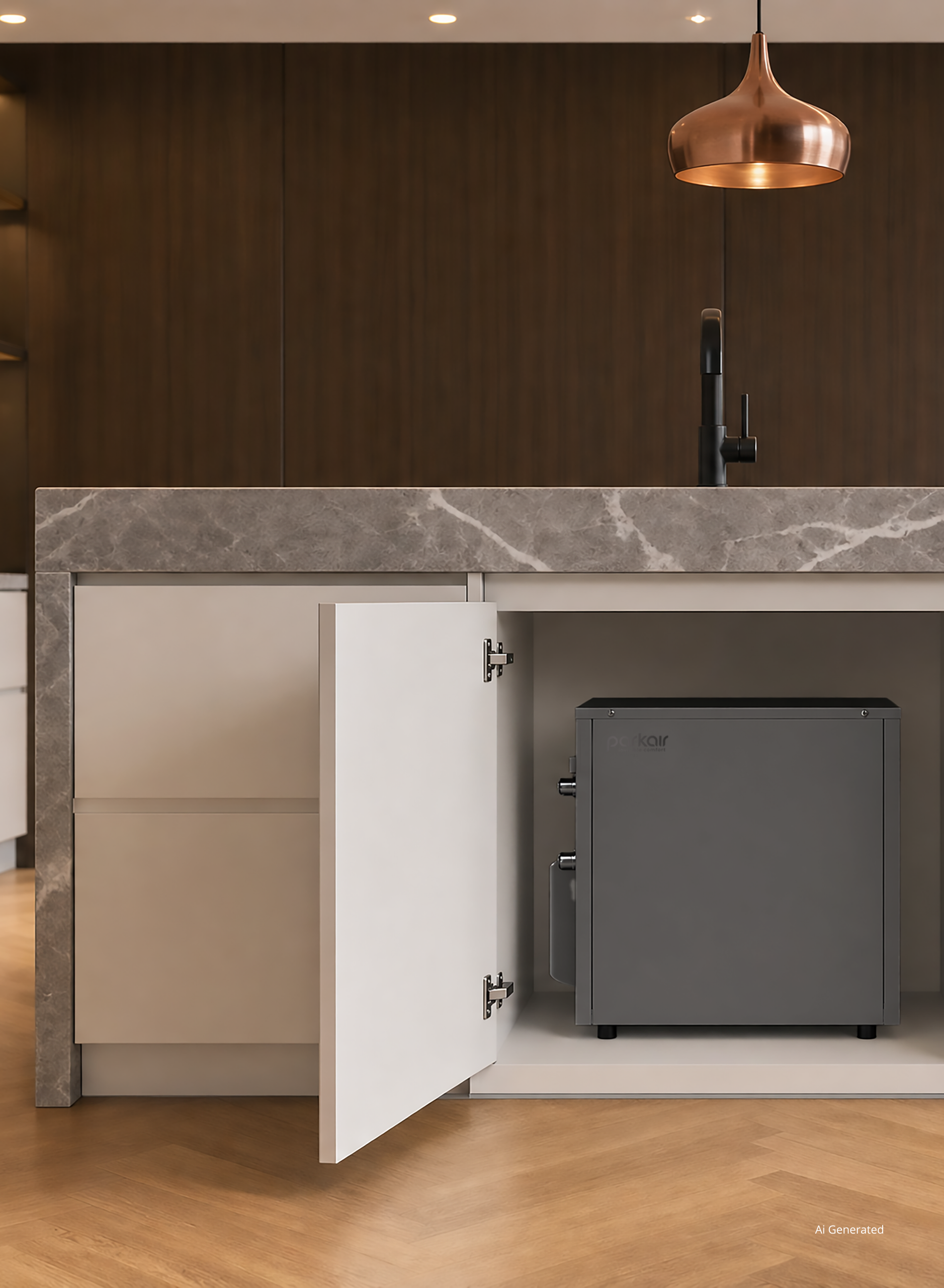
The compact size of our units allows installation under a bathroom sink, in a plant room, a laundry room, or a loft. All Water/Air systems generally run on a once-through water supply: they draw and discharge water for the heat exchange, with inverter technology and an electronic modulating valve helping to contain consumption. The exception is when the unit is connected to a shared water loop (WLHP) or to a recovery well: in these configurations, water is recirculated or returned to the source instead of being discharged, drastically reducing net consumption.
Why a Water/Air system is the natural choice in historic centres
The most immediate advantage of a Water/Air system is its invisibility. With no outdoor motor, it fits into any architectural context, including historic buildings and period villas, without altering their appearance.
A Water/Air system is designed to be installed inside the building, often close to living spaces, which makes noise control a design requirement rather than an afterthought. The MCW 2.0 range uses Panasonic DC Inverter compressors within a Full Inverter system (DC Inverter plus H2O Inverter), which continuously adjusts performance to limit temperature fluctuations and perceived noise.
Sound pressure levels start at 40 dB(A) on the smallest MCW 2.0 Monosplit model: low enough for installation in living spaces without the unit making itself heard. On the water side, the electronic modulating valve of the H2O Inverter system, designed and engineered by Parkair, keeps water consumption in check, which varies depending on output and operating mode (cooling or heating).
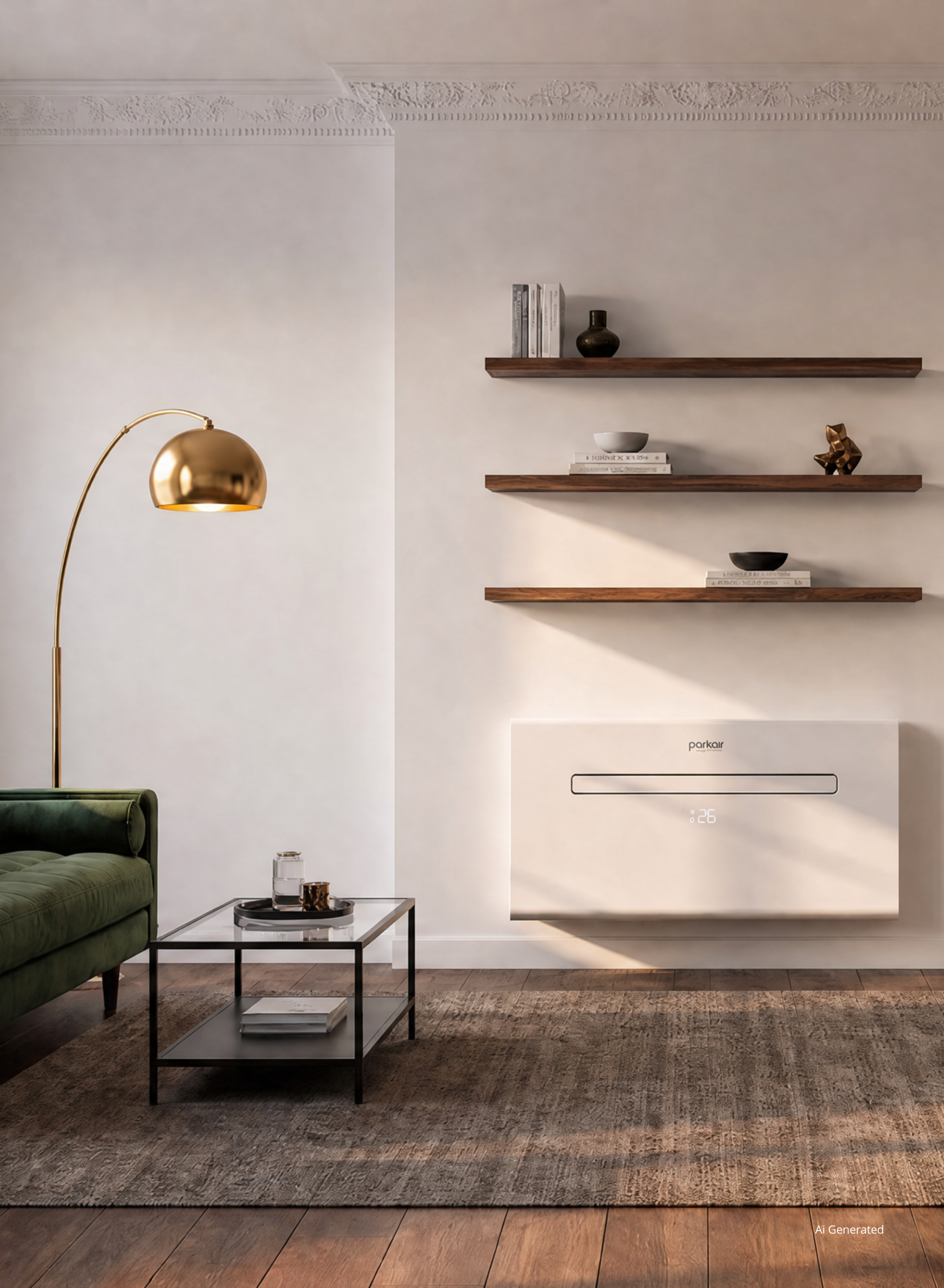
For those looking for a monoblock Water/Air system, the range offers two options: AiROCK Acqua, a single wall-mounted unit installed in the room to be conditioned, with a sealed refrigerant circuit that requires no F-Gas certification for installation; and MCWD, the ducted single-unit system for installation in a plant room or false ceiling, designed for higher outputs and to serve multiple rooms. In both cases heat exchange takes place through the water circuit: no holes, no grilles facing outside.